
Why Can’t Every Cavity Be Fixed With a Filling?
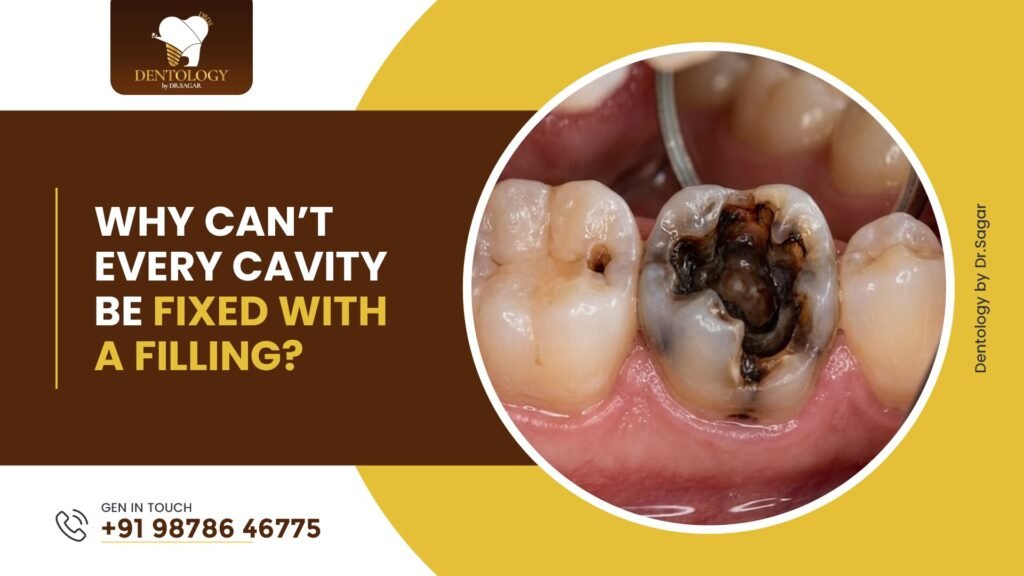
When you have a cavity, it may seem like the solution should be simple. Remove the decay, put in a filling, and the tooth is fixed. That works for many cavities, but not all of them. Tooth decay can affect different parts of a tooth and can vary in depth. In some cases, enough healthy tooth structure may remain for a regular filling. In other cases, the decay may be deep, the tooth may be badly damaged, or the pulp inside the tooth may be affected. The treatment then needs to be different. This is why your dentist may recommend a filling for one cavity but suggest a crown or root canal treatment for another. What Does a Dental Filling Do? A dental filling is used to repair a tooth that has been damaged by decay. During the procedure, the dentist removes the decayed part of the tooth and fills the space with a suitable material. The aim is to restore the tooth’s shape and function while stopping the damaged area from causing further problems. Fillings are commonly used when the tooth can be restored without treating the pulp inside it. But a filling cannot solve every type of tooth damage. Why Can’t Every Cavity Be Fixed With a Filling? There are a few important reasons. 1. The Cavity May Be Very Deep Tooth decay can start in the outer layer of the tooth and gradually move deeper. If the decay has progressed significantly, it may get close to the pulp. The pulp is the soft part inside the tooth that contains nerves and blood vessels. A deep cavity needs careful evaluation. Simply placing a filling may not be enough if the pulp has also been affected. The American Dental Association describes tooth decay as a disease process that can progress from early lesions to more extensive cavities. The treatment depends on the stage and condition of the tooth. 2. Too Much of the Tooth May Be Damaged A filling replaces the part of the tooth that has been lost because of decay. But what happens when a large part of the tooth is already gone? In that situation, there may not be enough strong tooth structure to support a regular filling. A dentist may recommend a dental crown or another type of restoration when the tooth needs more support and protection. A crown covers the tooth and can be used to restore a tooth that has been significantly damaged by decay or other problems. 3. The Decay May Have Reached the Pulp The pulp is located in the centre of the tooth. It contains nerves and blood vessels. When deep decay reaches the pulp, it can cause inflammation or infection. At this point, a filling alone may not solve the problem. Root canal treatment may be recommended to remove the diseased pulp, clean the inside of the tooth and seal it so the tooth can be restored. However, a deep cavity does not automatically mean that you need a root canal. The dentist needs to assess the tooth and determine the condition of the pulp before deciding on treatment. 4. The Tooth May Need More Protection A large cavity can weaken the tooth when a significant amount of its structure is lost. While a filling can repair the damaged area, it may not always provide enough support for the remaining tooth. Depending on the extent of the damage, your dentist may recommend a crown or another type of restoration. The aim is to protect the tooth, restore its function and reduce the risk of further damage. Does a Deep Cavity Always Need a Root Canal? No. This is an important point. A deep cavity and an infected pulp are not the same thing. Some deep cavities can be managed without removing the pulp, depending on the condition of the tooth and the clinical findings. Modern dental treatment can involve conservative approaches in suitable cases. The American Association of Endodontists notes that treatment decisions for deep decay depend on factors such as the depth of the decay and the condition of the pulp. So, if your dentist says that you have a deep cavity, it does not automatically mean that a root canal is required. When Does a Cavity Need a Root Canal? Root canal treatment may be needed when the pulp inside the tooth becomes seriously inflamed or infected. Deep tooth decay is one possible cause. Cracks, trauma, and repeated dental procedures can also affect the pulp. Some signs that may need attention include: Persistent tooth pain Pain when biting or chewing Sensitivity to hot or cold that lasts Swelling around the tooth Signs of infection A badly damaged or decayed tooth