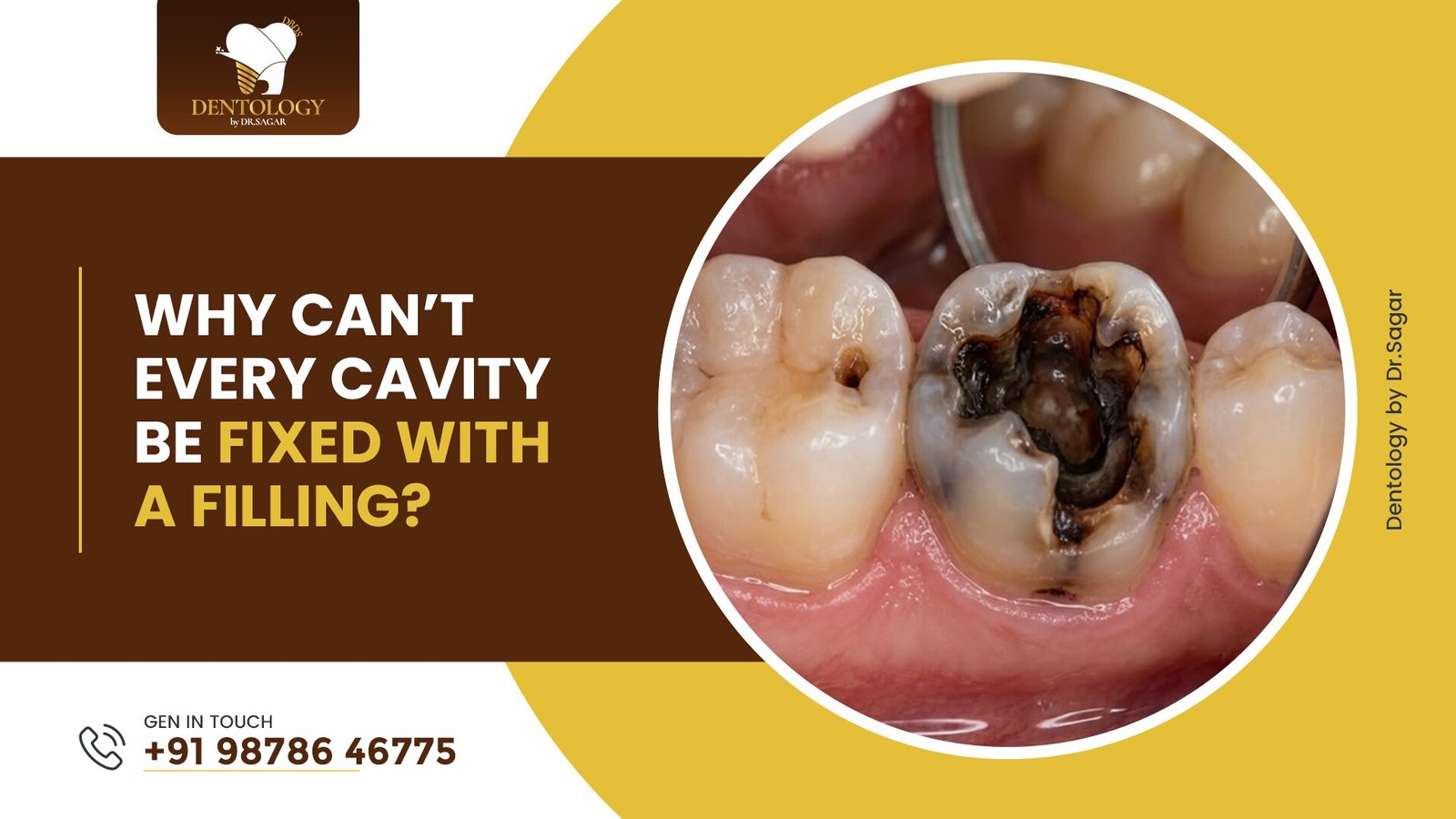
When you have a cavity, it may seem like the solution should be simple. Remove the decay, put in a filling, and the tooth is fixed.
That works for many cavities, but not all of them.
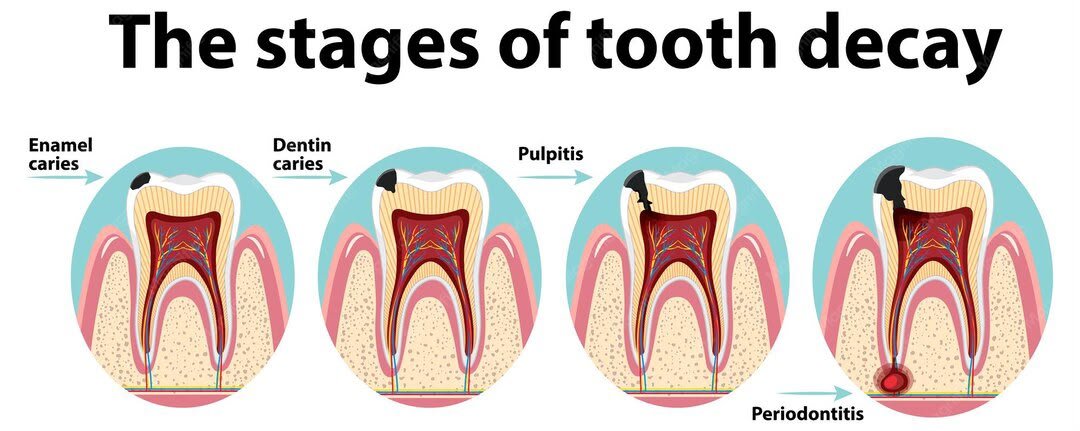
Tooth decay can affect different parts of a tooth and can vary in depth. In some cases, enough healthy tooth structure may remain for a regular filling. In other cases, the decay may be deep, the tooth may be badly damaged, or the pulp inside the tooth may be affected. The treatment then needs to be different.
This is why your dentist may recommend a filling for one cavity but suggest a crown or root canal treatment for another.
What Does a Dental Filling Do?
A dental filling is used to repair a tooth that has been damaged by decay.
During the procedure, the dentist removes the decayed part of the tooth and fills the space with a suitable material. The aim is to restore the tooth’s shape and function while stopping the damaged area from causing further problems.
Fillings are commonly used when the tooth can be restored without treating the pulp inside it.
But a filling cannot solve every type of tooth damage.
Why Can’t Every Cavity Be Fixed With a Filling?
There are a few important reasons.
1. The Cavity May Be Very Deep
Tooth decay can start in the outer layer of the tooth and gradually move deeper.
If the decay has progressed significantly, it may get close to the pulp. The pulp is the soft part inside the tooth that contains nerves and blood vessels.
A deep cavity needs careful evaluation. Simply placing a filling may not be enough if the pulp has also been affected.
The American Dental Association describes tooth decay as a disease process that can progress from early lesions to more extensive cavities. The treatment depends on the stage and condition of the tooth.
2. Too Much of the Tooth May Be Damaged
A filling replaces the part of the tooth that has been lost because of decay.
But what happens when a large part of the tooth is already gone?
In that situation, there may not be enough strong tooth structure to support a regular filling.
A dentist may recommend a dental crown or another type of restoration when the tooth needs more support and protection.
A crown covers the tooth and can be used to restore a tooth that has been significantly damaged by decay or other problems.
3. The Decay May Have Reached the Pulp
The pulp is located in the centre of the tooth. It contains nerves and blood vessels.
When deep decay reaches the pulp, it can cause inflammation or infection.
At this point, a filling alone may not solve the problem.
Root canal treatment may be recommended to remove the diseased pulp, clean the inside of the tooth and seal it so the tooth can be restored.
However, a deep cavity does not automatically mean that you need a root canal.
The dentist needs to assess the tooth and determine the condition of the pulp before deciding on treatment.
4. The Tooth May Need More Protection
A large cavity can weaken the tooth when a significant amount of its structure is lost. While a filling can repair the damaged area, it may not always provide enough support for the remaining tooth.
Depending on the extent of the damage, your dentist may recommend a crown or another type of restoration. The aim is to protect the tooth, restore its function and reduce the risk of further damage.
Does a Deep Cavity Always Need a Root Canal?
No.
This is an important point.
A deep cavity and an infected pulp are not the same thing.
Some deep cavities can be managed without removing the pulp, depending on the condition of the tooth and the clinical findings. Modern dental treatment can involve conservative approaches in suitable cases.
The American Association of Endodontists notes that treatment decisions for deep decay depend on factors such as the depth of the decay and the condition of the pulp.
So, if your dentist says that you have a deep cavity, it does not automatically mean that a root canal is required.
When Does a Cavity Need a Root Canal?
Root canal treatment may be needed when the pulp inside the tooth becomes seriously inflamed or infected.
Deep tooth decay is one possible cause. Cracks, trauma, and repeated dental procedures can also affect the pulp.
Some signs that may need attention include:
- Persistent tooth pain
- Pain when biting or chewing
- Sensitivity to hot or cold that lasts
- Swelling around the tooth
- Signs of infection
- A badly damaged or decayed tooth
These symptoms do not tell you exactly which treatment you need. A dentist may need to examine the tooth and take an X-ray or perform other tests before making a diagnosis.
Filling vs Root Canal vs Crown
These treatments serve different purposes.
| Treatment | When it may be used | Main purpose |
| Dental filling | Decay that can be restored directly | Replace the damaged tooth structure |
| Root canal treatment | Pulp that is significantly inflamed or infected | Treat the inside of the tooth |
| Dental crown | A tooth with substantial structural damage | Cover and protect the remaining tooth |
A root canal and a crown are not the same treatment.
A root canal deals with the inside of the tooth. A crown covers the tooth and helps restore its shape and strength.
In some cases, a tooth may need both treatments.
How Does a Dentist Decide What Treatment You Need?
There is no single rule that applies to every cavity.
Your dentist may look at several things before recommending treatment.
How deep is the decay?
The dentist needs to determine how far the decay has progressed.
Is the pulp affected?
The condition of the pulp is important when deciding whether root canal treatment may be necessary.
How much healthy tooth remains?
If a large portion of the tooth has been lost, a simple filling may not provide enough support.
What symptoms are you experiencing?
Pain, sensitivity, and discomfort can provide useful information, but symptoms alone cannot confirm the diagnosis.
Is an X-ray needed?
An X-ray can help the dentist see areas that cannot be properly assessed during a visual examination.
Can the tooth be restored?
The dentist also needs to determine whether there is enough healthy tooth structure to restore the tooth properly.
This is why two people with what they both describe as a “cavity” may receive different treatment recommendations.
Can a Deep Cavity Still Be Saved?
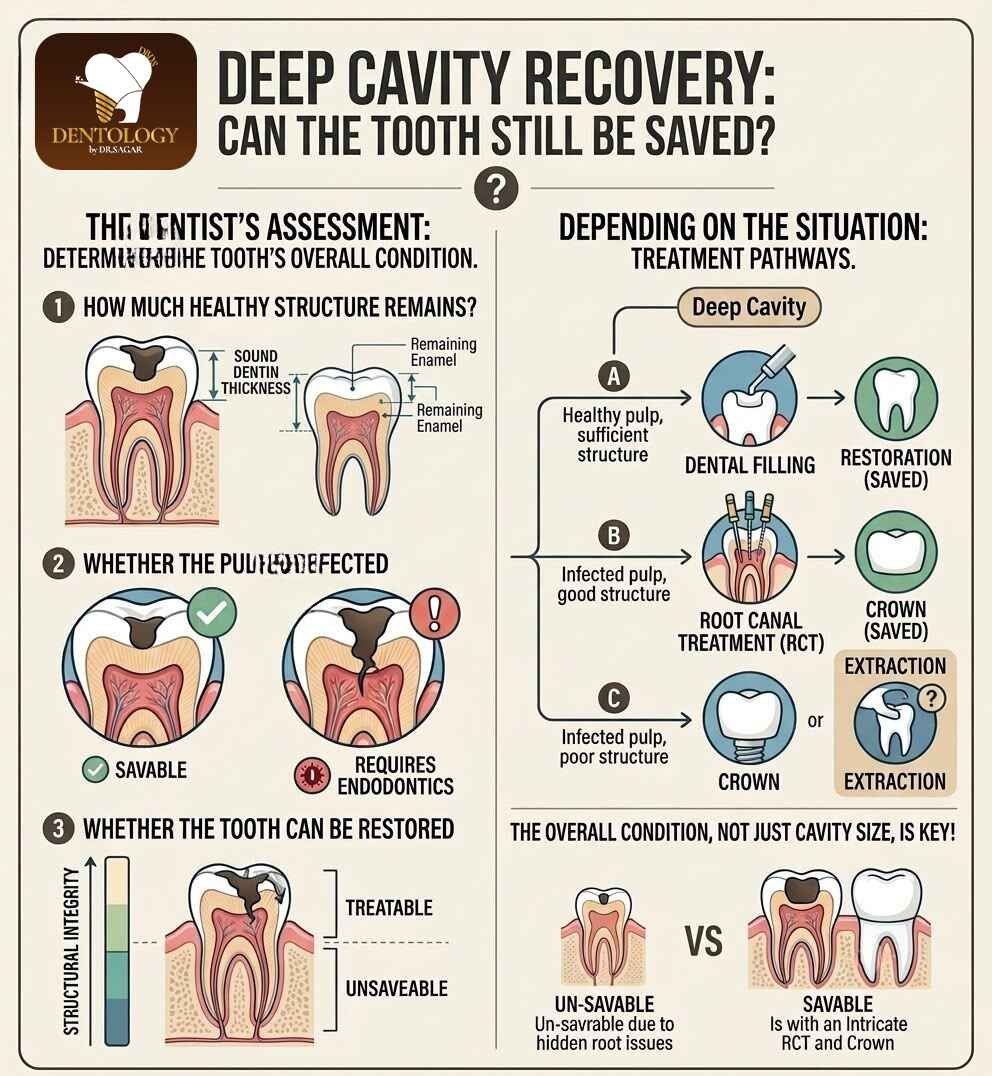
In many cases, a badly damaged tooth may still be treatable.
The answer depends on how much healthy tooth structure remains, whether the pulp is affected and whether the tooth can be restored properly.
Depending on the situation, treatment may involve a filling, another type of dental restoration, root canal treatment, a crown or, in some cases, extraction.
The important question is not simply how large the cavity looks.
The dentist needs to assess the tooth’s overall condition.
What Happens If You Leave a Cavity Untreated?
A cavity does not always cause severe pain at the beginning.
That does not mean the decay has stopped.
As tooth decay progresses, more of the tooth can become damaged. If the decay reaches deeper parts of the tooth, treatment may become more complicated.
Getting a cavity checked early gives your dentist a chance to assess the tooth before the damage becomes more extensive.
When Should You See a Dentist?
You should arrange a dental examination if you notice:
- A visible hole in a tooth
- A dark or discoloured area
- Tooth sensitivity
- Pain when eating or drinking
- Pain when biting
- Food getting stuck repeatedly around one tooth
- A broken or weakened tooth
- Swelling around the tooth
- Persistent toothache
Do not wait for severe pain before getting a cavity checked.
Some dental problems can progress without causing obvious symptoms in the early stages.
Cavity Treatment in Ludhiana
If you have been told that you have a cavity and are unsure whether you need a filling, root canal treatment, or another type of restoration, a dental examination can help clarify the situation.
Dentology by Dr. Sagar in Model Town, Ludhiana provides dental restoration, root canal treatment, dental X-rays, and other dental services.
Dr. Sagar is a Prosthodontist and Dental Implantologist with postgraduate training in Prosthodontics and Crown & Bridge. The clinic also provides treatment for patients with more complex restorative and dental problems.
The appropriate treatment depends on the condition of your individual tooth.
Frequently Asked Questions
Can every cavity be fixed with a filling?
No. Some cavities can be treated with a filling, while deeper or more extensive decay may require another type of treatment.
Can a deep cavity be filled?
Sometimes. The treatment depends on the depth of the decay, the condition of the pulp, and how much healthy tooth structure remains.
When does a cavity need a root canal?
A root canal may be needed when the pulp inside the tooth becomes significantly inflamed or infected. Deep decay is one possible cause.
Does every deep cavity need a root canal?
No. A deep cavity does not automatically mean that a root canal is required. The dentist needs to assess the condition of the tooth and pulp.
Why would I need a crown instead of a filling?
A crown may be recommended when a tooth has lost a substantial amount of structure and needs more coverage and protection than a regular filling can provide.
What happens if a cavity reaches the nerve?
If decay affects the pulp and causes significant inflammation or infection, root canal treatment may be recommended. The exact treatment depends on the clinical diagnosis.
Can a badly decayed tooth still be saved?
Sometimes. It depends on how much healthy tooth structure remains, the condition of the pulp and whether the tooth can be restored properly.
Can a cavity cause pain when biting?
Yes. A cavity can be associated with pain when biting, although several other dental problems can cause the same symptom. An examination is needed to find the cause.
Final Thoughts
A cavity does not always mean that you need a simple filling.
The right treatment depends on how far the decay has progressed, how much healthy tooth structure remains, and whether the pulp inside the tooth has been affected.
For some patients, a filling may be enough. Others may need a crown, root canal treatment or another form of dental restoration.
If you have been told that a filling is not enough, ask your dentist what they found during the examination and why a particular treatment has been recommended.
Getting the tooth checked early can help you understand the problem and the available treatment options before the damage becomes more extensive.